Once upon a time, getting a stone chip in your windscreen was a minor annoyance. You’d call a mobile glass repair service, they’d meet you in a car park, swap the glass in an hour, and you’d pay a relatively small amount of cash.
If you own a modern car built in the last few years, those days are gone.
Today, when you receive a quote for a windscreen replacement, the price is often triple what it used to be. Furthermore, the technician might tell you the car needs to be taken into a workshop for several hours, or even a full day.
It’s natural to feel like you’re being overcharged. But the truth is, you aren’t just paying for a new piece of glass anymore. You are paying to reset your car’s eyes.
The “Eye” Behind the Mirror
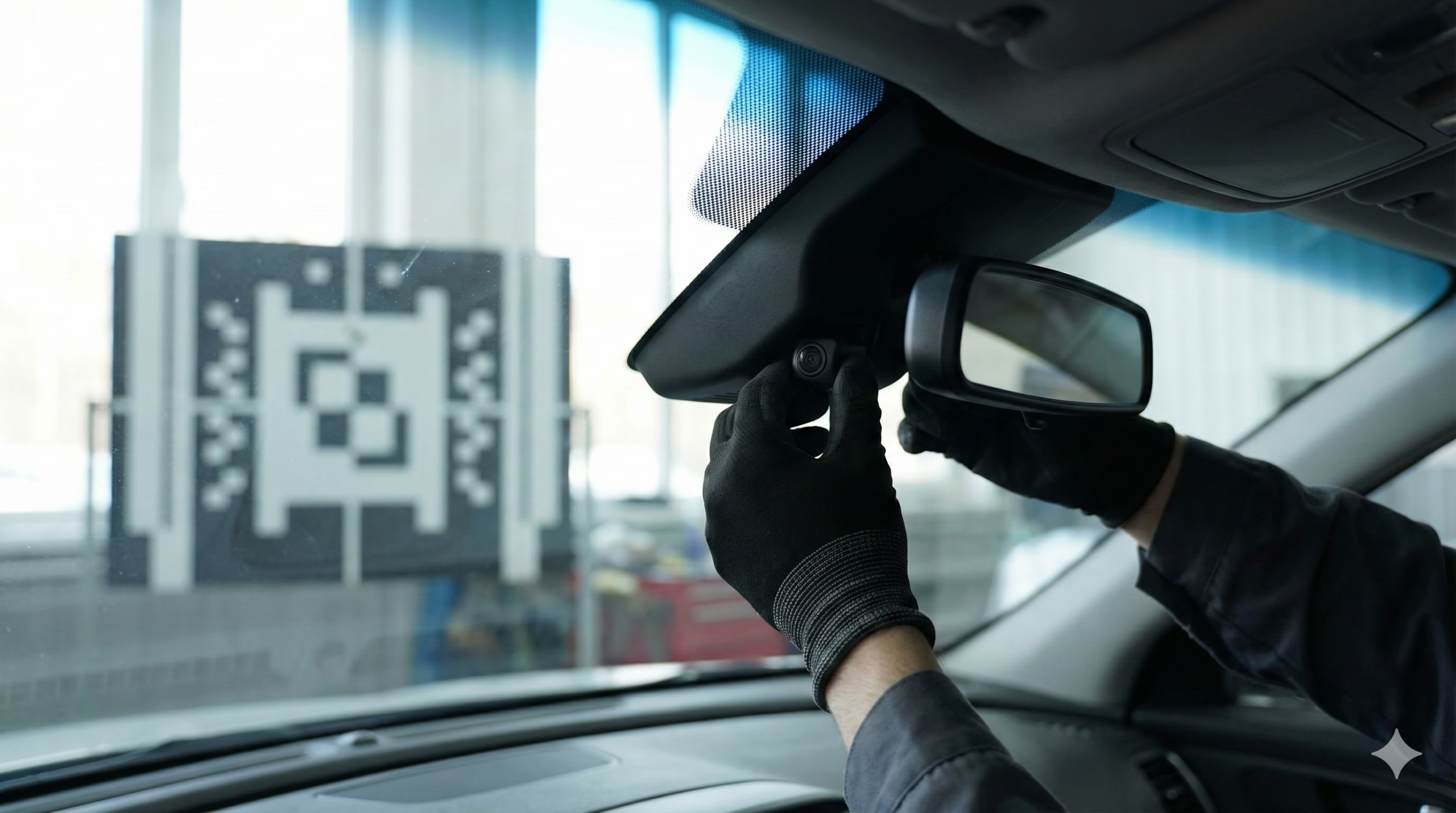
The reason for the increased cost and complexity lies in a small black box located near your rearview mirror, pressed tight against the inside of the windscreen.
This is your Front-Facing Camera (FFC). It is the critical component for many Advanced Driver Assistance Systems (ADAS), including:
- Lane Keep Assist: The camera “sees” the white and yellow lines on the road.
- Automatic Emergency Braking (AEB): The camera identifies vehicles and pedestrians ahead to trigger braking if you don’t react.
- Traffic Sign Recognition: It literally reads speed limit signs as you pass them.
- Adaptive High Beams: It detects oncoming headlights and dips your lights automatically.
Crucially, this camera does not look at the glass; it looks through it.
The Glass is a Lens
To a high-precision camera, a windscreen isn’t just a wind blocker; it’s an optical lens.
When a factory builds a car, the camera is precisely aligned to look through the original glass. The car’s computer knows exactly how that specific piece of glass refracts (bends) light.
When you replace the windshield—even with high-quality glass—there will be microscopic differences in its shape, clarity, and curvature compared to the original. Furthermore, the new glass might sit in the frame a fraction of a millimetre differently than the old one.
To a human, these differences are invisible. To a computer that calculates distances based on pixels, these differences are massive.
If the camera angle changes by just one degree, down the road at highway speeds, the car’s perception of where the lane lines are could be off by several feet.
The Necessary Step: Calibration
This is where the extra cost and time come in. Every time a windshield is replaced on an ADAS-equipped car, the camera system must be recalibrated.
Calibration is the process of teaching the car’s computer exactly where the new glass is and how to look through it accurately. It resets the “baseline” for safety.
There are two main ways technicians do this, and both take time and expensive equipment:
1. Static Calibration
This happens in a controlled workshop environment. The car is parked on a perfectly level floor. The technician places highly accurate “target boards” (which look like patterned signs) at precise distances and heights in front of the car. A scan tool is plugged into the car, forcing the camera to find these targets and align itself to them.
2. Dynamic Calibration
This involves driving the car on public roads. The technician plugs in a scan tool and drives a specific route at a set speed, usually requiring clear lane markings and minimal traffic. The camera enters a “learning mode” and recalibrates itself based on the real-world environment.
What Happens If You Skip It?
Some drivers, shocked by the price or the time requirement, ask if they can just skip the calibration.
The short answer is: No.
If you replace the glass without calibrating the camera, your safety systems may seem to work, but they will be operating with bad data. This can lead to unpredictable and dangerous behaviour:
- Lane Drift: The car might think it’s centered in the lane when it’s actually drifting over the line.
- Phantom Warnings: The system might detect obstacles that aren’t there because the focus is off.
- Late Braking: Most critically, if the distance calculation is wrong, the Automatic Emergency Braking might engage too late—or not at all—in a real emergency.
Conclusion: The Price of Safety
Modern cars are incredibly safe, but that safety relies on precision technology. The windscreen is no longer just a window; it is an integral part of a complex safety system.
When you pay that higher price for a replacement, you aren’t just buying glass. You are buying the assurance that when you desperately need your car to see the road clearly, it can.

Hiran Alwis is an automotive lecturer and ADAS specialist with over 15 years of experience in diagnostics, advanced safety systems, and technical training. He founded ADAS Project to help everyday drivers and workshop technicians understand and safely use advanced driver assistance systems.